CS2 is one of the most competitive first-person shooters available right now, and that intensity is exactly what keeps players hooked. But climbing the ranks takes more than raw hours queued up in matchmaking. The players who improve consistently are doing something different with the time they spend between games.
The gap between a player who stagnates and one who keeps growing usually comes down to how they structure their off-match practice. Below are the smart methods that actually move the needle.
Build Your Aim on Structured Training Maps
Aim is the foundation of everything in CS2. You can have solid communication and positioning, but inconsistent mechanics under pressure will cost rounds regardless. The fastest path to reliable aim is focused repetition before you enter a competitive lobby.
Table of Contents
Use Steam Workshop Maps Every Session
The Steam Workshop gives players free access to dedicated training tools built around CS2. Three types of maps earn a permanent spot in a daily routine:
- Recoil Master – Spray Training – Dedicated to learning weapon recoil patterns with a visual guide that shows the ideal spray path. You can see exactly where your control breaks down after each burst.
- Yprac Prefire Maps – Places you inside real competitive angles and drills you on prefiring common positions. It builds crosshair habits in situations that actually reflect match play.
- General aim training maps – Use them for 10–15 minutes at the start of each session to activate mechanics before anything else. Jumping into ranked without warming up means cold aim and slow reflexes.
Get Spray Control Right Before Ranked Play
Most players spray without truly understanding how their weapon’s recoil moves. Here is a practical drill to fix that:
- Load into an offline server and fire 30 bullets at a close wall without compensating.
- Observe the direction the pattern pulls.
- On your next attempt, pull your mouse in the opposite direction to counter it.
- Repeat 10 times. It takes about five minutes per session.
- Start with the AK-47 first since it is the most punishing but rewarding, then move on to the M4A4 or M4A1-S.
At longer distances, use short 5–7 bullet bursts instead of full sprays. Full auto at range almost always loses to a player who taps or bursts with accuracy.
Use Demo Review to Fix Habits You Cannot Feel In-Game
The players who improve fastest do not only play. They study. They review their own habits and turn vague frustration into specific corrections. Demo review is the most underused improvement tool among casual CS2 players.
Know Exactly What to Look For
After each match, go back and watch two or three rounds where you died in a way that felt off. Focus on the setup before the duel, not just the duel itself. Check these three things every time:
- Crosshair placement – Was your aim at head height before the peek, or were you adjusting upward when the enemy appeared?
- Counter-strafe timing – Were you fully stopped when you fired? CS2’s sub-tick system registers your shot at the exact millisecond you click, so any residual movement directly degrades your accuracy.
- Utility – Did your smoke or flash create a real advantage, or was it thrown out of habit with no follow-up?
Study How Pros Make Decisions
Watching pro CS2 demos is not about copying aim styles. Pay attention to how a CT player holds an angle with a flash already in the air, or how a T-side lurker waits for sound cues before committing to a push. Strong players review process before outcome, asking what information was available and whether the move made sense.
Train Movement and Map Knowledge at the Same Time
Poor movement makes even a solid aim look inconsistent. In CS2, mechanics and positioning are closely connected, and training them together speeds up both.
Make Counter-Strafing Automatic
Counter-strafing means pressing the opposite movement key to stop your character’s momentum before firing. Moving left with A? Tap D briefly to kill your movement before pulling the trigger.
A practical drill that works:
- Load into deathmatch.
- Strafe left, counter-strafe, fire one shot. Strafe right, counter-strafe, fire one shot.
- Repeat until the sequence feels like a single natural motion, not a conscious three-step process.
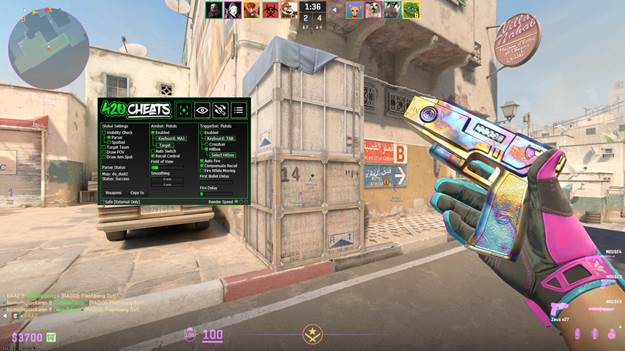
Some frustrated players look for shortcuts like CS2 Cheats to skip the mechanical grind. But building counter-strafing as a real reflex is what consistently separates mid-rank players from those at the top levels.
Learn Your Map Rotations
Pick two competitive maps and spend time in offline practice mode timing your rotations. Take time to learn how long it takes to rotate from one position to another using walk or run. This knowledge directly changes how you make decisions mid-round.
A few things to check on your core maps:
- How long B-to-A rotation takes at run speed versus walk speed
- Which early positions give information without overexposing you
- Where utility shuts down the most dangerous crossfire angles on each site
Map knowledge combined with utility practice gives you a structural edge that pure aim cannot replace.
Build a Pre-Match Warm-Up Routine
Jumping cold into ranked is one of the most common causes of slow early-round performance. A good warm-up prepares three things at once: your mechanics including aim, recoil, and movement; your decision-making around angle discipline and timing; and your mental focus.
A Warm-Up Structure That Works
- 5 minutes on a Workshop aim training map with fast-moving bots
- 5 minutes on Recoil Master focused on AK-47 spray control
- 10 minutes of Deathmatch on a competitive map, focusing entirely on crosshair placement
- 5 minutes reviewing two clips from your last match
The goal is not topping the deathmatch scoreboard. It is clean first shots, consistent counter-strafing, and composed movement before your competitive rounds start.
Final Thoughts
Improving in CS2 comes from deliberate repetition, not just more hours logged. Structure your aim training around Workshop maps, review your demos with a focus on process, fix your movement mechanics at the habit level, and warm up before every session. These steps compound. The ceiling you feel right now is mostly a reflection of the habits you have not addressed yet.