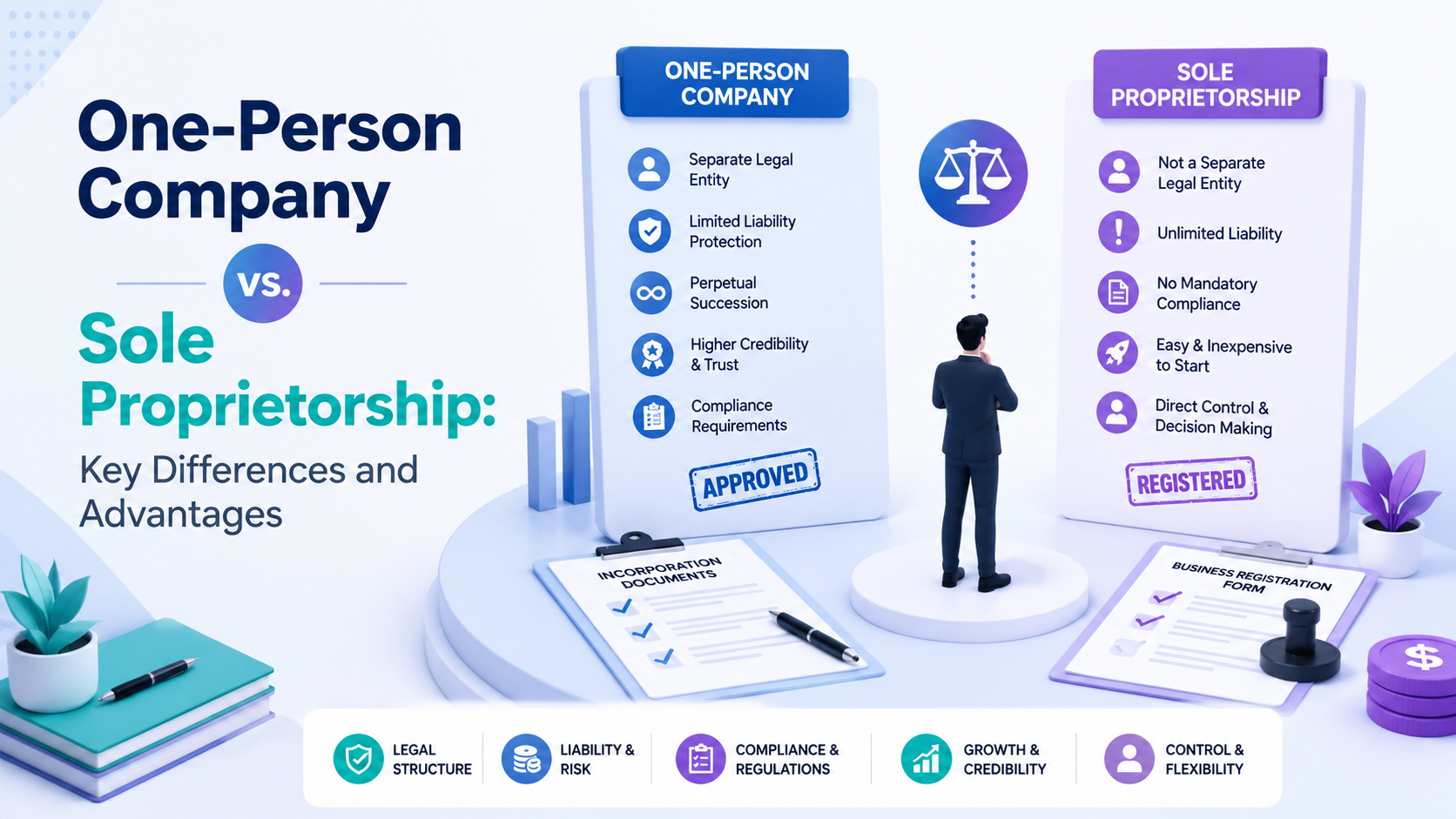
For solo founders, the entrepreneurial path is filled with critical decisions. Yet before you launch your first marketing campaign or build your product, your most vital step is to select your legal foundation.
If you are starting a business on your own in 2026, you generally face a choice between two primary legal structures: a Sole Proprietorship and a One Person Company (OPC).
While both entities allow a single individual to own and control a business, they sit on opposite ends of the corporate spectrum. A Sole Proprietorship is the simplest, unincorporated form of business. At the same time, an OPC is a formal corporate structure introduced by the Companies Act to give solo founders the power of a separate legal entity.
This guide analyses the core differences, advantages, and operational realities of both options to help you determine which structure is best for your solo venture.
What is a One Person Company (OPC)?
A One Person Company is a registered corporate entity that allows a single shareholder to enjoy the benefits of incorporation. Introduced to promote micro-entrepreneurship, an OPC requires only 1 shareholder and 1 director (who can be the same person). Unlike a proprietorship, it is a registered corporation with the Ministry of Corporate Affairs (MCA) and requires a nominee director to ensure perpetual existence.
- Best For: Solo tech founders, specialised service providers, and product-based business owners who require high corporate credibility, corporate contracts, and asset protection.
What is a Sole Proprietorship?
A Sole Proprietorship is an unincorporated business owned and operated by a single individual. In this framework, there is no legal distinction between the owner and the business itself. The business operates under the owner’s personal Permanent Account Number (PAN), and all liabilities, profits, and debts flow directly to the individual.
- Best For: Freelancers, independent consultants, local merchants, and solo creators starting with low financial risk and minimal upfront capital.
Key Structural Differences
| Feature | Sole Proprietorship | One Person Company (OPC) |
| Legal Status | Identical to the owner | Separate legal entity |
| Liability Exposure | Unlimited (Personal risk) | Limited to the unpaid share capital |
| Owner Limit | Exactly 1 owner | Exactly 1 shareholder |
| Nominee Requirement | Not applicable | Mandatory 1 Nominee Director |
| Governance Law | No specific corporate act | Companies Act, 2013 |
| Average Headline Taxes | Individual Income Tax Slabs (up to 30%) | Flat Corporate Tax (normally 22% base plus cess/surcharge) |
| Annual Audit | No (Unless Tax Audit applies under the IT Act) | Yes, mandatory statutory audit |
| Transferability | Non-transferable | Transferable through share transmission |
Advantages of a One Person Company (OPC)
If you are looking to build a highly credible, secure brand, choosing an OPC offers several distinctive advantages over a standard proprietorship:
Table of Contents
1. Limited Liability Protection
The most significant benefit of an OPC is limited liability. Because the OPC is a separate legal entity, the shareholders’ liability is strictly limited to the nominal value of the shares they hold. If the business defaults on a loan, files for bankruptcy, or faces a lawsuit, the founder’s personal savings, home, and assets are completely protected.
2. Unmatched Business Credibility
Corporate buyers, multinational clients, and banking institutions routinely prefer dealing with registered corporate entities over individual proprietors. An OPC registration signals compliance, structure, and permanency, making it significantly easier to secure enterprise contracts and open corporate bank accounts.
3. Perpetual Succession
A sole proprietorship ceases to exist upon the death or incapacitation of its owner. Conversely, an OPC enjoys perpetual succession. During incorporation, the founder appoints a “Nominee Director.” If the sole director passes away or becomes unable to work, the nominee immediately takes over control of the company, ensuring business operations continue without legal bottlenecks.
4. Better Access to Corporate Credit
Banks and financial institutions view registered companies as lower-risk borrowers compared to sole proprietors. An OPC can easily secure credit lines, equipment financing, and commercial business loans backed by corporate credit profiles rather than purely relying on the founder’s personal credit score.
Advantages of a Sole Proprietorship
While an OPC offers powerful structural protections, starting as a Sole Proprietorship carries practical operational advantages:
1. Zero Structural Setup Barriers
A sole proprietorship can be established in a matter of days. Since there is no central MCA registration, you simply obtain local functional licenses, such as a GST registration, a Shop and Establishment license, or a Udyam registration, and begin trading immediately.
2. Extremely Low Compliance Overhead
An OPC must maintain books of accounts, hold annual general meetings, file corporate tax returns, and submit audited financial statements to the Registrar of Companies (RoC) annually.
A Sole Proprietorship, however, has virtually no annual corporate filings. Unless your business turnover triggers a tax audit threshold, you simply declare your business profits alongside your personal income tax return.
3. Immediate Capital Access
In a sole proprietorship, the business’s bank account is tied directly to your personal tax profile. Any profit generated by the business can be withdrawn or transferred instantly for personal use without the need to declare dividends, process director salaries, or account for corporate withholding taxes.
Making Your Decision: How to Choose
To determine which entity fits your roadmap, consider these 3 parameters:
- What is your operational risk? If your business involves trading physical inventory, managing complex client contracts, renting commercial real estate, or taking on business loans, the safety net of an OPC is highly recommended to protect your personal estate.
- Who is your target client? If you are pitching services directly to large corporations or government bodies, they often require a corporate registration (like an OPC or Pvt Ltd) to onboard you as a vendor. If you work primarily with individuals or small businesses, a Sole Proprietorship is perfectly adequate.
- What is your administrative runway? If you want to direct 100% of your early focus toward sales without spending money or time on mandatory chartered accounting audits, company secretarial fees, and annual MCA filings, start as a Sole Proprietor and transition to a corporate structure later.
Seamless Business Onboarding
Your choice of business entity lays the legal foundation for your venture, shaping everything from compliance and taxation to future growth opportunities.
However, selecting the right structure is only the first step. Ensuring that registrations, tax requirements, and banking processes are set up correctly from the outset can save significant time and effort later.
Modern digital platforms have made this process far simpler. Platforms like Razorpay Rize bring together business registration and documentation into a single streamlined experience, helping solo founders launch with confidence and compliance.