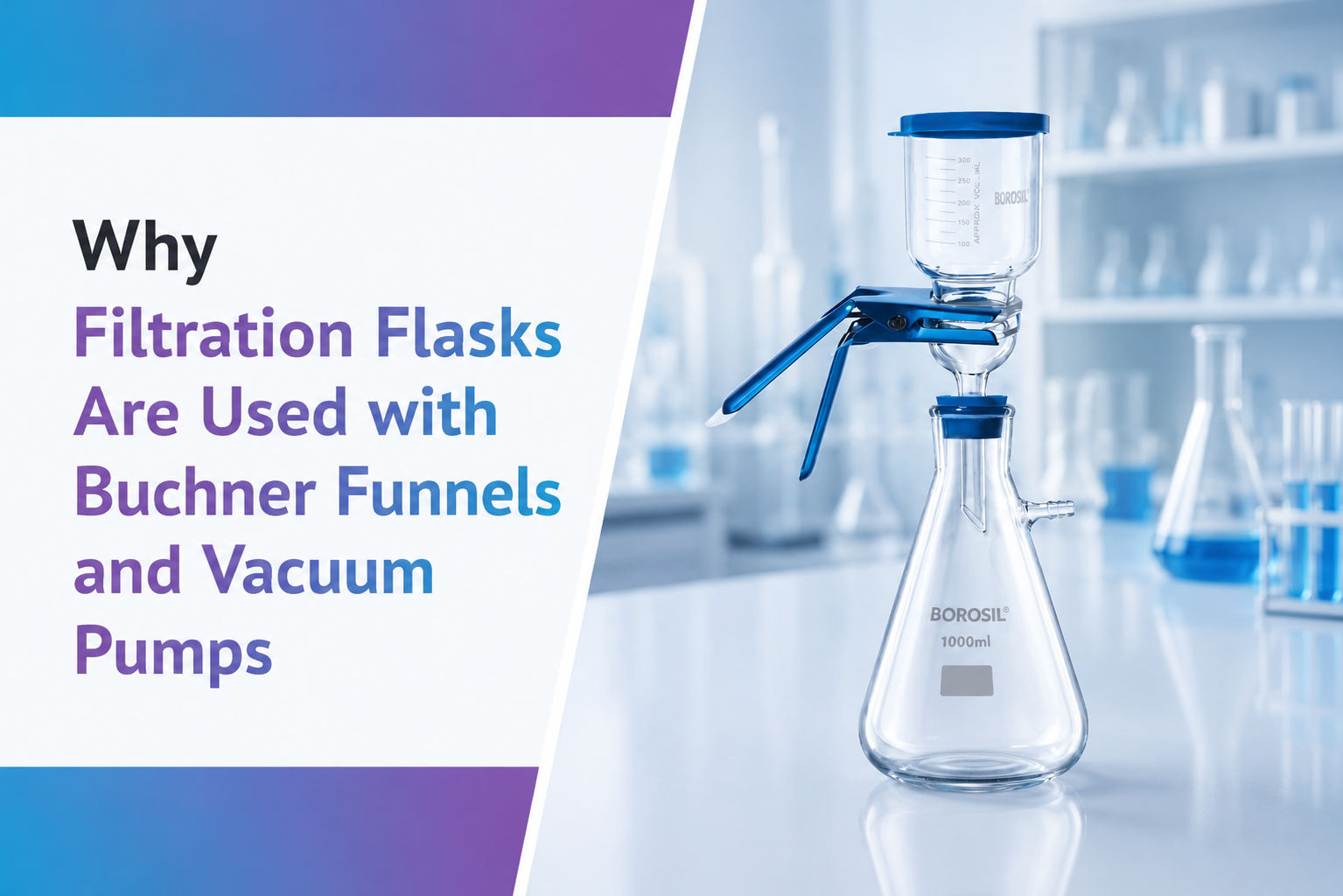
Efficient solid-liquid separation is essential in many laboratory workflows where speed and reproducibility matter. Filtration flasks are commonly used alongside Buchner funnels and vacuum pumps because they provide the sealed environment needed to generate reduced pressure for vacuum filtration. This combination accelerates filtration, improves efficiency and supports cleaner separation of solids from liquids across a range of laboratory applications.
Understanding the Role of Each Component in a Vacuum Filtration Setup
A vacuum filtration setup relies on three components that work together to complete the separation process. Each has a specific role, as explained below:
- Buchner Funnel: Holds the filter paper and the sample mixture. The filter paper traps the solid particles while allowing the liquid to pass through.
- Filtration Flask: Collects the filtered liquid and provides a side connection for attaching the vacuum source, helping maintain reduced pressure throughout the process.
- Vacuum Pump: Removes air from the system to create reduced pressure, which draws the liquid through the filter paper more rapidly than gravity alone.
- Combined Operation: When connected correctly, these components function as one system, allowing solids and liquids to separate efficiently while supporting a controlled filtration process.
The effectiveness of vacuum filtration depends on all three components working together, with each contributing a distinct function.
Why a Filtration Flask Is Essential for Vacuum Filtration
Unlike an ordinary laboratory flask, a filtration flask is designed to operate safely under reduced pressure. Its construction allows it to perform reliably while supporting the vacuum filtration process.
Several design features make it suitable for this application:
- Side Arm Connection: The side arm provides a secure connection between the flask and the vacuum tubing, allowing reduced pressure to develop inside the flask.
- Mechanical Strength: The flask is blown in special moulds to provide the mechanical strength required for vacuum filtration. This construction helps it withstand the reduced pressure generated during the process.
- Stable Design: The bottle-shaped construction contributes to the flask’s mechanical strength while supporting the collection of the filtrate during vacuum filtration.
- Secure Stopper Fit: The neck is designed to accommodate a suitable stopper, helping maintain the vacuum throughout the filtration process.
Filter flasks from manufacturers such as Borosil Scientific are blown in special moulds and incorporate glass tubulation to provide mechanical strength during vacuum filtration. These design features help the flask withstand reduced pressure and distinguish it from standard laboratory glassware intended for general use.
How Vacuum Improves the Filtration Process
The main purpose of using a vacuum pump is to increase the speed and efficiency of filtration. Instead of relying only on gravity, the vacuum creates a pressure difference that draws the liquid through the filter paper more quickly.
This approach is particularly useful when filtering fine precipitates or samples that naturally pass through the filter paper at a slower rate. The increased flow rate helps reduce waiting time and allows laboratory procedures to continue more efficiently.
Vacuum filtration often leaves the collected solid with less residual liquid than gravity filtration. As a result, the sample may require less time for subsequent drying or further processing. By combining reduced pressure with suitable laboratory glassware, the filtration process becomes both faster and more consistent.
Practical Advantages of Using a Filtration Flask with Buchner Funnels and Vacuum Pumps
Using a filtration flask together with a Buchner funnel and a vacuum pump provides several practical benefits during routine laboratory work. Some of the key advantages include:
- Faster Filtration: Reduced pressure accelerates the movement of liquid through the filter paper, shortening filtration time.
- Efficient Solid-Liquid Separation: Reduced pressure helps separate solids from liquids more efficiently during filtration.
- Reliable Filtrate Collection: The flask safely collects the filtered liquid while maintaining the vacuum connection.
- Improved Laboratory Workflow: Shorter filtration times allow experiments and sample preparation to progress more efficiently.
- Safer Vacuum Operation: A filtration flask is specifically designed for reduced-pressure applications, making it more suitable than ordinary laboratory flasks for vacuum filtration.
Together, these advantages make this setup a practical choice for laboratory filtration where reliable performance, efficient separation and safe operation are required.
Conclusion
A filtration flask is an essential part of a vacuum filtration setup because it is designed to work with a Buchner funnel and a vacuum pump under reduced pressure. Its specialised construction supports safe operation while enabling faster and more efficient solid-liquid separation than gravity filtration alone. Using the correct combination of laboratory equipment helps achieve reliable filtration results and supports consistent laboratory practices across a wide range of scientific applications.