14 September 2026: First ministers of Scotland, Wales, and Northern Ireland signed a joint statement in Cardiff calling on Westminster to allow their nations to determine their own constitutional futures. John Swinney, Rhun ap Iorwerth, Michelle O’Neill, and Sinn Fin leader Mary Lou McDonald pledged closer cooperation on self-determination, the economy, energy, and relations with the EU.
Swinney has maintained that the simultaneous election of pro-independence first ministers across all three devolved nations demonstrates that the status quo is “not sustainable.”
Prime Minister Andy Burnham — who succeeded Keir Starmer in July — has declared another Scottish referendum “off-limits,” even as he has shown a slightly greater willingness to consider Northern Ireland’s constitutionally unique route to a vote.
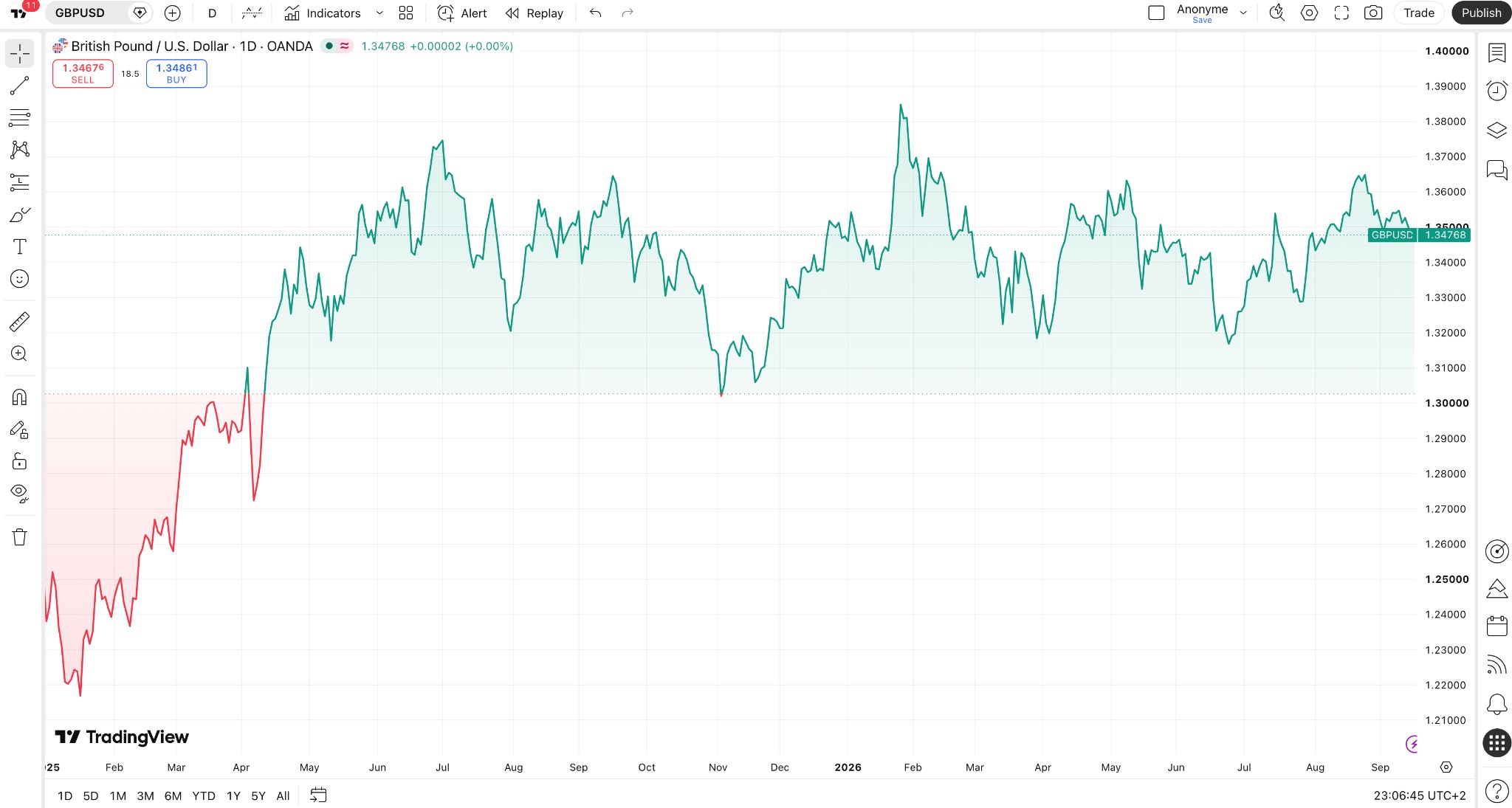
Whatever the outcome, the economic implications of a break-up of the UK would be profound, uneven across the three nations, and more contingent on the details of negotiation than the principle of separation. Such a break-up would likely be reflected in the GBPUSD chart, alongside the UK economic releases tracked in the economic calendar, though how much would depend on those same negotiation details.
Any push for independence begins with the Scots’ own numbers. The latest Government Expenditure and Revenue Scotland (GERS) estimates put Scotland’s notional deficit at 25.3 billion in 2025-26 — equivalent to 10.9% of gross domestic product — more than twice the UK average of 4.2%.
Compared to Wales or Northern Ireland, that deficit is driven far more by higher spending (tax revenue, by contrast, is roughly similar) than by weaker tax collection, which is nearly identical to the UK-wide level. Economists at the Fraser of Allander Institute have suggested a deficit of this size would be “unsustainable” without significant tax rises or spending cuts, unless there was a “material and sustained” increase in economic output.
Currency remains a contentious issue: having ruled out a formal currency union in 2014, Westminster has made clear it has no plans to revisit that stance. Scotland’s independence plans propose informal sterling use during a transition period, with the eventual adoption of a new currency “as soon as practicable” — language that is likely to cause headaches for bond traders.
Northern Ireland, meanwhile, has its own legal route to independence, enshrined in the Good Friday Agreement. It also has its own economics. The UK’s financial “subvention” to Northern Ireland — an estimate of the funding gap between its spending and tax revenue — was 10.7 billion in 2019, while the cost to an Irish government of absorbing Northern Ireland’s population post-unification is estimated to be anywhere from 2.8 billion to 23.8 billion, depending on assumptions about welfare expenditure, pensions, and debt-sharing arrangements.
It’s that wide range that has helped explain why, despite political momentum toward Irish reunification, the polls have consistently indicated a majority of voters on either side would prefer not to pay increased taxes to get there. One potential upside: automatic re-entry into the EU single market, which would eliminate the frictions on Ireland’s trade that have come with Brexit.
Wales faces particularly significant fiscal challenges, as its own notional deficit per capita — driven by relatively low tax revenues — exceeds Scotland’s.
Support for outright independence remains quite low at 13.6%, according to the 2026 Welsh Election Study. This may explain why Plaid Cymru, despite becoming the largest party in the Welsh Parliament in May, campaigned largely on further devolution rather than independence, including more money from Westminster for Crown Estate receipts, rail infrastructure, and levies on devolved taxes.
Losing Scotland would entail significant, costly complications for the rest of the UK — namely, relocating the Trident nuclear submarine fleet from its current base in Faslane, near Glasgow — and a potentially more protracted negotiation over how the UK’s national debt would be divided. Such discussions could unsettle both gilts and credit ratings, regardless of the outcome of any negotiations.
On the global stage, the immediate effects would be limited to market and diplomatic adjustments, as Scotland contributes around 8% of UK revenue and wouldn’t cause a macroeconomic shock. The UK’s global economic position may also be shaped by a new internal customs boundary, if an independent Scotland and a united Ireland stay in the EU single market and England and Wales don’t.
President Donald Trump’s trip to Ireland just days before the Cardiff summit injected an idiosyncratic international element, with the US president calling Irish reunification “one of the natural ones of all time,” though he refused to comment on Scottish independence.
What happens economically will ultimately depend less on the merits of the case for or against secession than on the specifics of negotiations over debt, currency, and EU membership, none of which have yet been defined.