Are you facing challenges in making your startup a success? Are the hurdles in your way stopping you from going ahead? Are you scared of taking up challenges? Then read this article, and you too will know how these entrepreneurs tackled tough situations to become successful. This will inspire you to do something big.
Here are 10 Indian entrepreneurs who started with almost nothing in hand and yet were able to build multi-million-dollar companies and huge empires.
| # | Founder | Started with | Lesson |
|---|---|---|---|
| 01 | Sridhar VembuZoho Corp. | No outside funding | You can build a big company without investors’ money if you stay focused on your customers. |
| 02 | Dr. A. VelumaniThyrocare | ₹1 lakh from his PF | Turn the skill you know best into your business. |
| 03 | Mahesh GuptaKent RO Systems | ₹20,000 savings | The best business ideas often come from a problem you face yourself. |
| 04 | Kailash KatkarQuick Heal | A calculator repair shop | Skills and hard work can matter more than degrees. |
| 05 | P C MustafaiD Fresh Food | ₹25,000 | Failing early in life does not decide your future. |
| 06 | Patricia NarayanRestaurant chain, Chennai | A snack cart on Marina Beach | Never let personal hardships stop you from working towards your goal. |
| 07 | Dhirubhai AmbaniReliance Industries | ₹50,000 (1958) | Think big, even when you start small. |
| 08 | Karsanbhai PatelNirma | Door-to-door selling | A low price and a good product can beat big brands. |
| 09 | Prem GanapathyDosa Plaza | Washing utensils in Mumbai | Good food, good service and a strong brand can turn a small stall into a franchise. |
| 10 | Kalpana SarojKamani Tubes | A small tailoring business | Where you start does not decide how far you can go. |
1. Sridhar Vembu
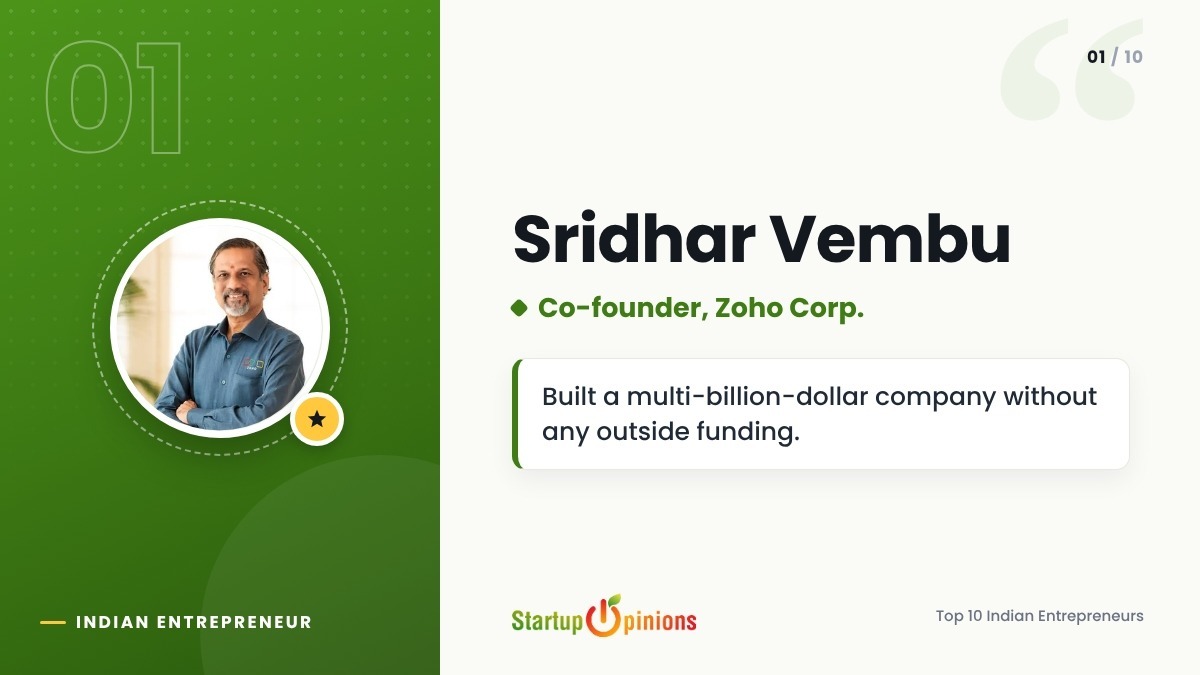
Sridhar Vembu is the co-founder of Zoho Corp. (formerly AdventNet Inc.). He led the company as its Chief Executive Officer for many years, and in January 2025, he stepped down as CEO to become Chief Scientist and focus on research and development. In 1996, he co-founded AdventNet, and he became its Chief Executive Officer in 2000. AdventNet has transformed itself from a software company serving network equipment vendors to an online applications provider.
Without any outside capital, the business maintained growth and profitability. Before AdventNet, Sridhar worked as a wireless systems engineer at Qualcomm, Inc. where he was lucky enough to work with some of the leading minds in wireless communications.
Sridhar Vembu’s Zoho gives stiff competition to some of the core products of Microsoft, Google and Salesforce.com. Vembu never let outside capital into Zoho Corp, and yet it has grown into a multi-billion-dollar company.
He was born in Chennai and grew up in a very modest middle-class family. His father was a stenographer in the High Court. His parents never went to college.
He went to a Tamil-medium, government-aided school till class 10, and then he completed his schooling in an English-medium government school.
He did well at school. He earned his Bachelor’s degree in Electrical Engineering from the Indian Institute of Technology (IIT), Madras, and a PhD in Electrical Engineering from Princeton University.
Lesson: You can build a big company without investors’ money if you stay focused on your customers.
2. Dr. Arokiaswamy Velumani
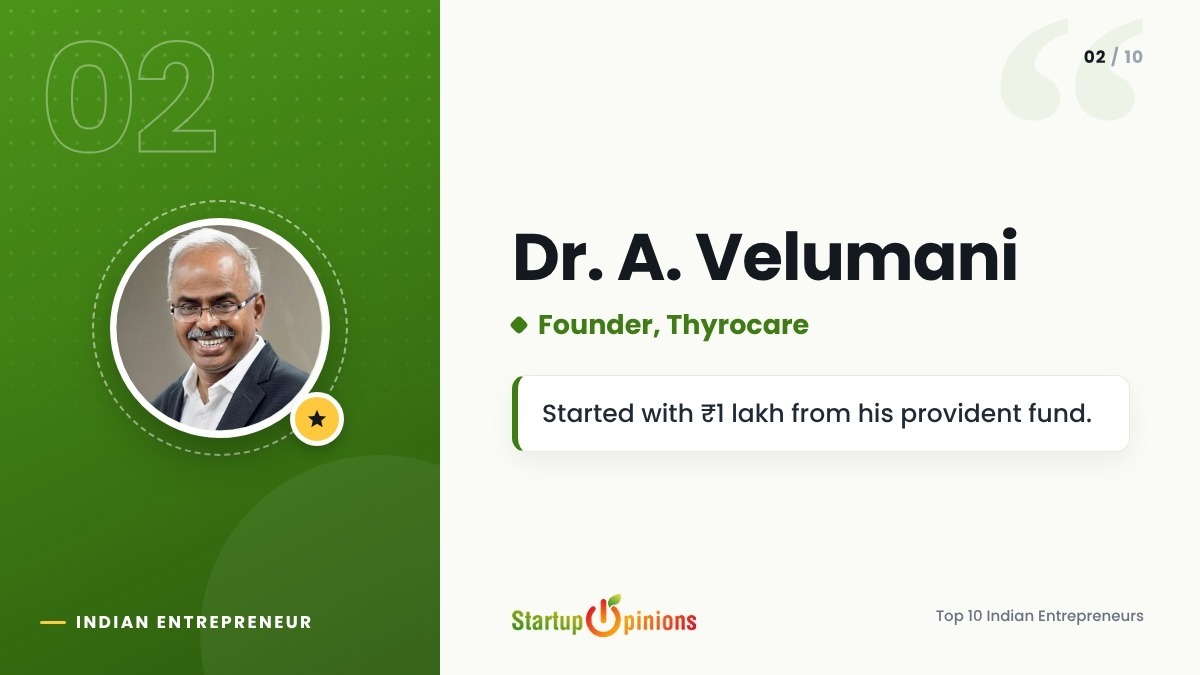
Dr. Arokiaswamy Velumani owns no car and lives in a small quarter above his large lab in Navi Mumbai. On most nights, he ends up sleeping in the lab.
He was born to a poor, landless farmer in the small village of Appanaickenpatti Pudur in Tamil Nadu. Velumani was so poor that he managed to go to school and college only through government subsidies.
He built Thyrocare, one of the world’s largest thyroid testing companies, which had around 1,122 testing outlets across India, Bangladesh, Nepal and the Middle East.
He started his career as a shift chemist at Gemini Capsules, a small pharmaceutical company in Coimbatore, in 1979, and earned a mere ₹150 per month. After three years, the company shut down and Velumani became jobless.
After fourteen years of service at the Bhabha Atomic Research Centre (BARC), Velumani put in his papers and decided to channel his expertise in thyroid biochemistry to set up testing labs that would detect thyroid disorders.
At the age of 37, he took ₹1 lakh from his provident fund to open a shop in Byculla, South Mumbai.
In May 2016, Thyrocare was worth ₹3,377 crore. Velumani owned a 64% stake in the company, which made his worth around ₹2,158 crore. In 2021, he sold a 66.1% stake in Thyrocare to PharmEasy for about ₹4,546 crore.He also started working on a subsidiary of the company to focus on cancer screening through molecular imaging.
Lesson: Turn the skill you know best into your business.
3. Mahesh Gupta
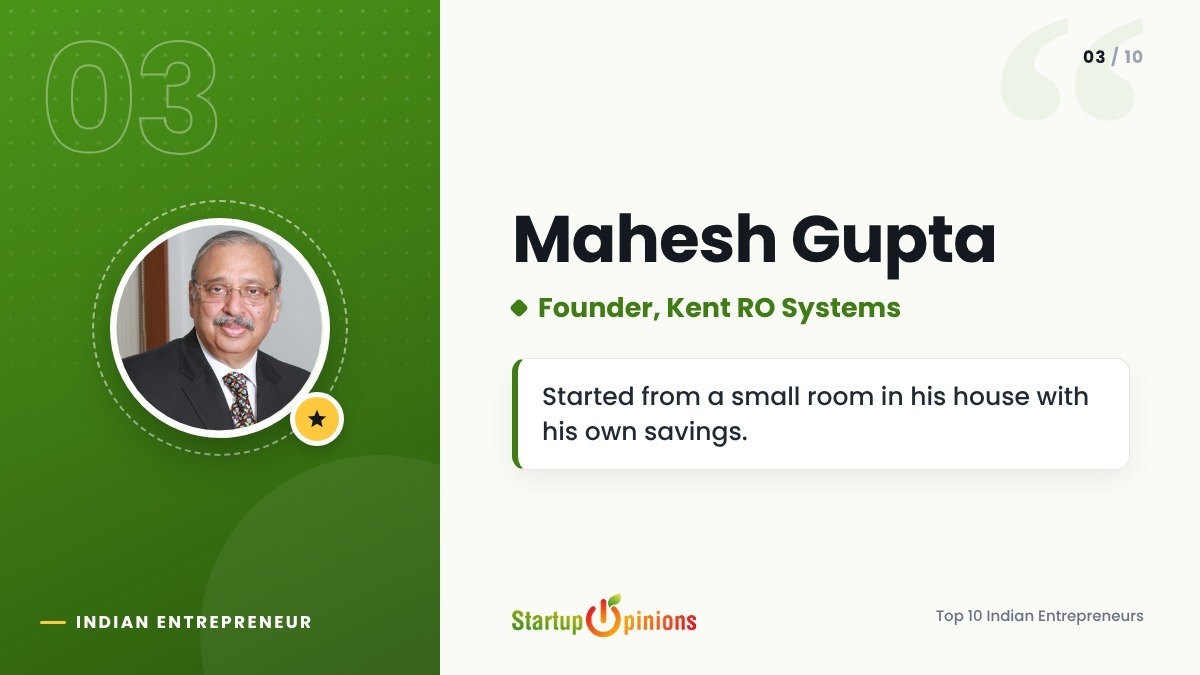
In 1985, Mahesh Gupta, a mechanical engineer, started his business from a small room in his house. He started with just ₹20,000 which he had saved from his job at IOCL and now he is the chairman of Kent RO Systems.
His first invention was a petroleum conservation instrument, which earned him a lot of fame and half a dozen patents.
The turning point of his life came with the establishment of Kent RO Systems, when he set out on a new enterprise. At that time, his son was suffering from jaundice. As jaundice is a water-borne disease, he researched and analysed all the water purifiers available in the market.
He was highly dissatisfied with the available options and decided to make a better quality purifier. After several trials, he came up with his own water purifier that was good enough to be marketed.
He started from scratch with an investment of just ₹1,00,000 and a team of 4 members.
Kent grew to a 40 percent share of the RO water purifier market, with a turnover of ₹580 crore and 2,500 employees.
Lesson: The best business ideas often come from a problem you face yourself.
4. Kailash Katkar
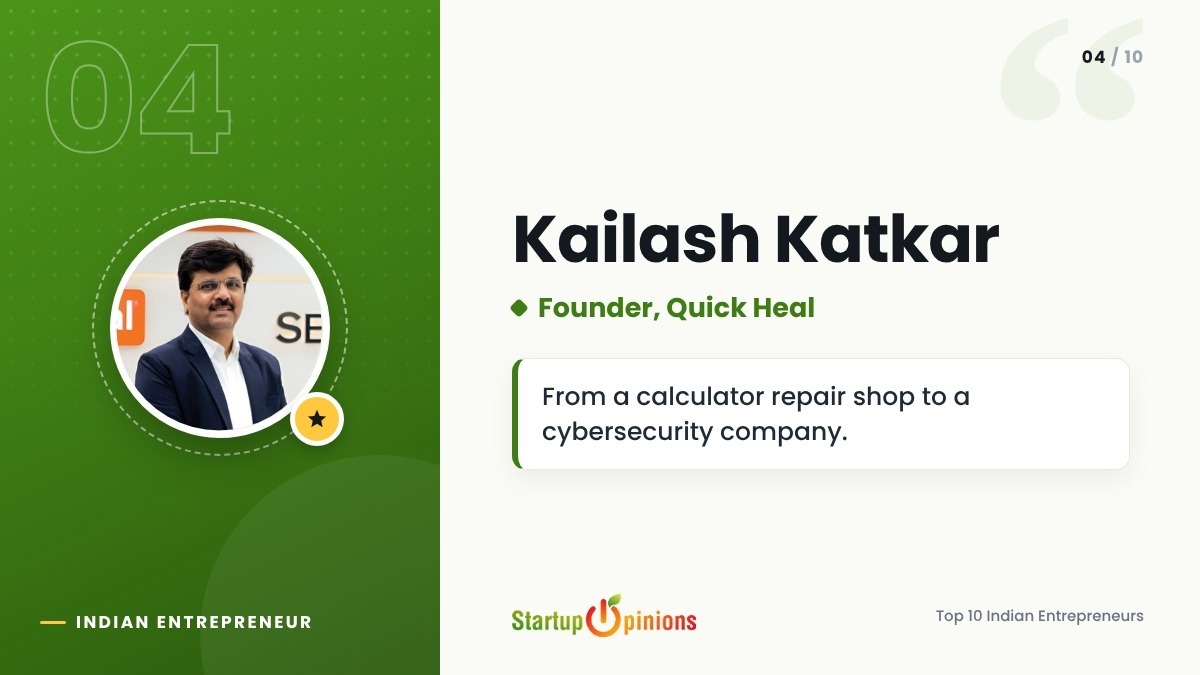
Kailash Katkar was born in the small village of Rahimatpur in Maharashtra. After a lot of effort, he was rewarded by becoming the Chairman and Chief Executive Officer of a ₹200 crore business, Quick Heal Technologies.He started with a job at a local radio shop. He also worked at a calculator repair shop. In 1990, he moved ahead to start his own business of calculator repairing.
In 1993, he started a new venture, CAT Computer Services. Without any formal higher education, and with the sharp application of his mind, he achieved success.
Lesson: Skills and hard work can matter more than degrees.
5. P C Mustafa
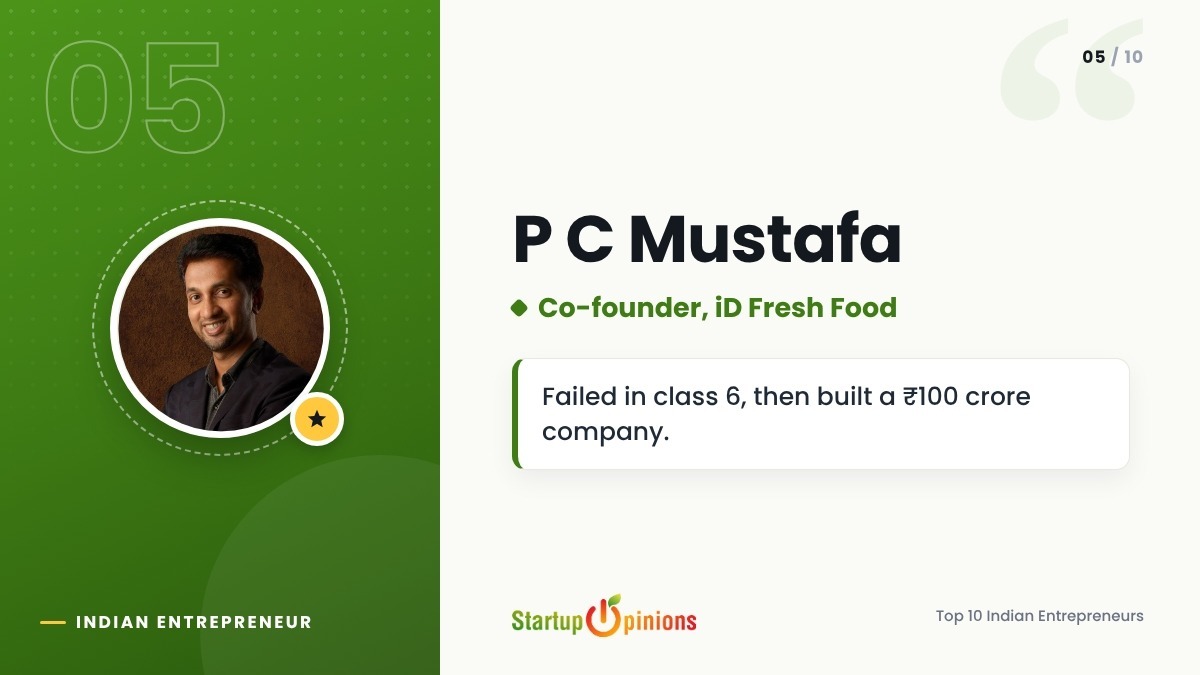
He is a man who failed in class 6 but went on to join the Regional Engineering College (now the National Institute of Technology), and the Indian Institute of Management (IIM), Bangalore.
His father was a coolie, so he did not get much financial support from his family. Still, he managed to build a ₹100 crore company with just ₹25,000.He became an entrepreneur and employed people from rural India.
His company, iD Fresh Food, produces fresh idli and dosa batter that reaches homes in Bengaluru, Chennai, Pune, Mumbai, Delhi, Hyderabad, Mangaluru and even Dubai.
It became a ₹100 crore company in October 2015. Its production has risen to 50,000 packets a day from just 10 packets a day in 2005. At that time, it had around 1,100 employees.
Lesson: Failing early in life does not decide your future.
6. Patricia Narayan
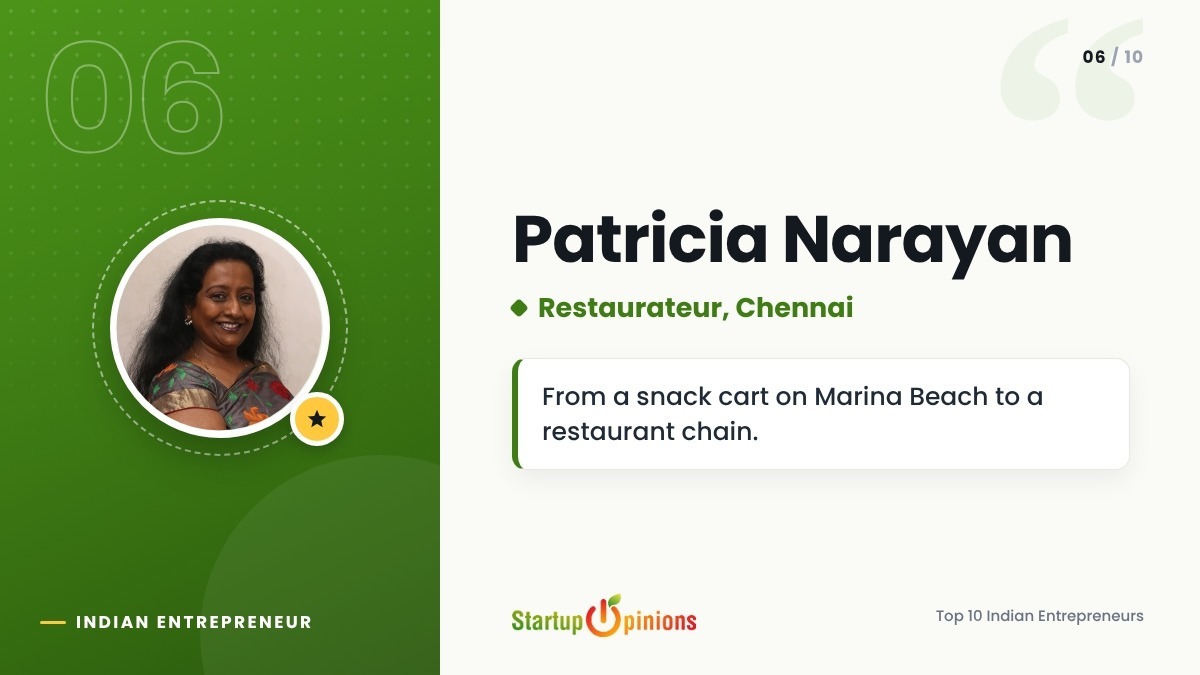
Patricia Narayan started her entrepreneurial career by selling snacks from a mobile cart on Chennai’s Marina Beach. She battled every hurdle in her life, whether it was an unsuccessful marriage, handling her husband, or taking care of her two kids alone.
She faced every challenge in her life. No hurdle stopped her; each one made her stronger, and now she runs a chain of restaurants.
She started her business with only 2 people and now, there are almost 200 people who are working under her in the restaurants. From earning almost nothing a day, her earnings grew to ₹2 lakh a day.
She worked hard, battled through every problem of her life for almost thirty years, and finally she was rewarded for her efforts. She received the FICCI Woman Entrepreneur of the Year award.
Lesson: Never let personal hardships stop you from working towards your goal.
Read Also: Women Empowerment: Benefit & Necessity
7. Dhirubhai Ambani
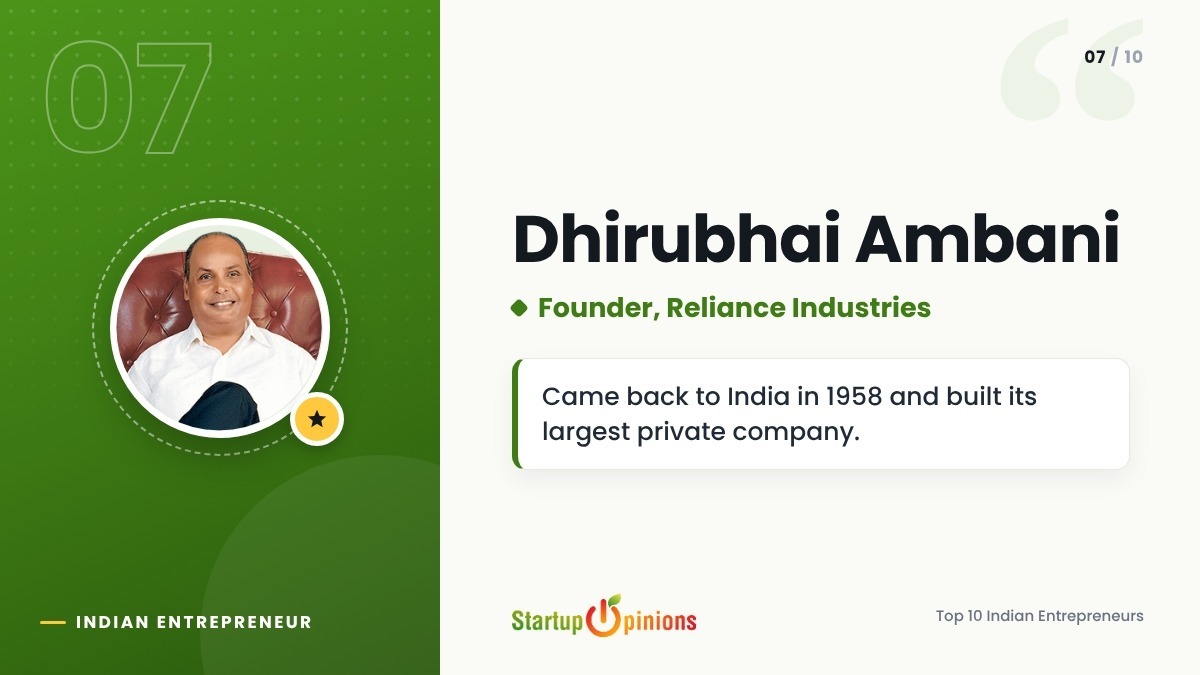
Dhirubhai Ambani, born Dhirajlal Hirachand Ambani, established India’s largest private sector company and created an equity cult in the Indian capital market. Reliance was the first Indian private sector company to feature in the Fortune Global 500 list. Dhirubhai Ambani was one of the most enterprising Indian entrepreneurs; he started a business from scratch and took it to millions of people.
He was the dazzling entrepreneur who rewrote the Indian corporate history and built a truly global corporate group.
He was born on December 28, 1932, at Chorwad, Gujarat, into a Modh family and his father was a school teacher. Dhirubhai Ambani started his career by selling bhajias to pilgrims at Mount Girnar during the weekends.
He completed his matriculation at the age of sixteen and then moved to Aden, Yemen. He returned to India in 1958 with INR 50,000 and established a textile trading company.
In 1992, Reliance became the first Indian company to raise money in global markets.
He was named the Indian Entrepreneur of the 20th Century by the Federation of Indian Chambers of Commerce and Industry (FICCI).
He died on July 6, 2002, in Mumbai.
Lesson: Think big, even when you start small.
8. Karsanbhai Patel
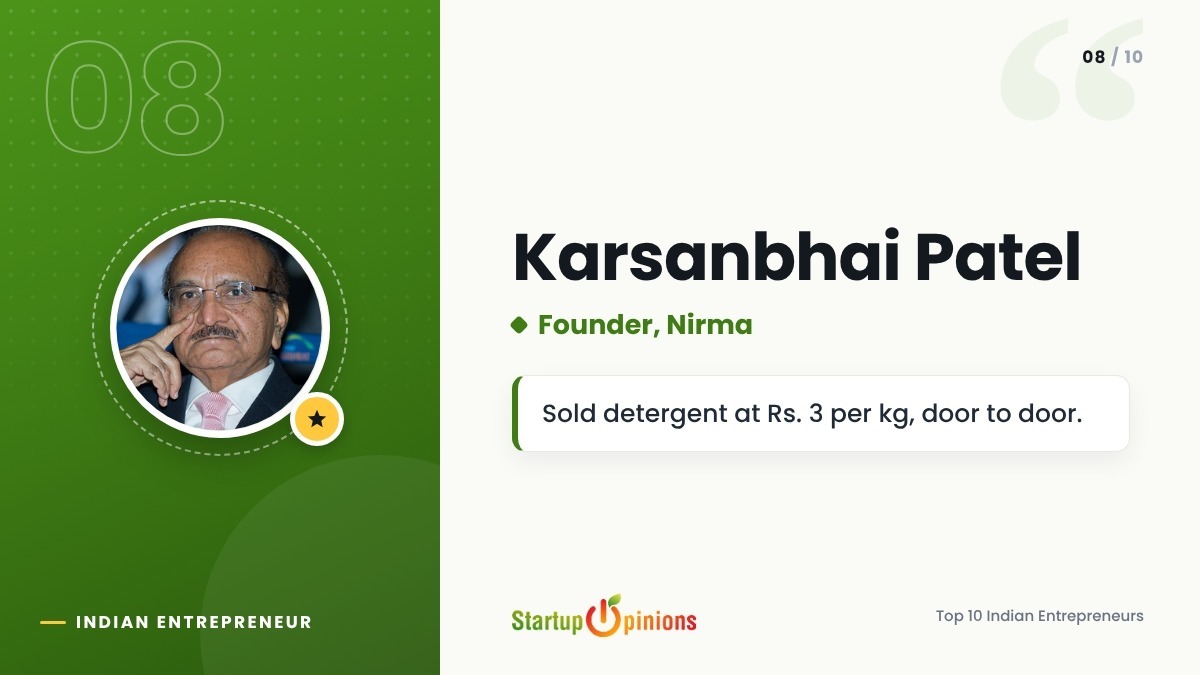
He is the man behind the washing powder NIRMA who started it in 1969. He was the Indian entrepreneur who took on the big MNCs and rewrote the rules of business. At that time, there were very few companies in the domestic detergent market, and they were mainly MNCs.
Karsanbhai used to make detergent powder in the backyard of his house in Ahmedabad and sell his handmade product door to door.
He came out with a detergent powder priced at Rs. 3 per kg at a time when the cheapest detergent was Rs. 13 per kg. Hence, he was able to successfully target the middle and lower-middle income segment.
His detergent powder, Nirma, became a huge success. The company was started with just one man who used to deliver his product from door to door. The same company grew to employ around 14,000 people, with a turnover of more than $500 million.
Lesson: A low price and a good product can beat big brands.
9. Prem Ganapathy
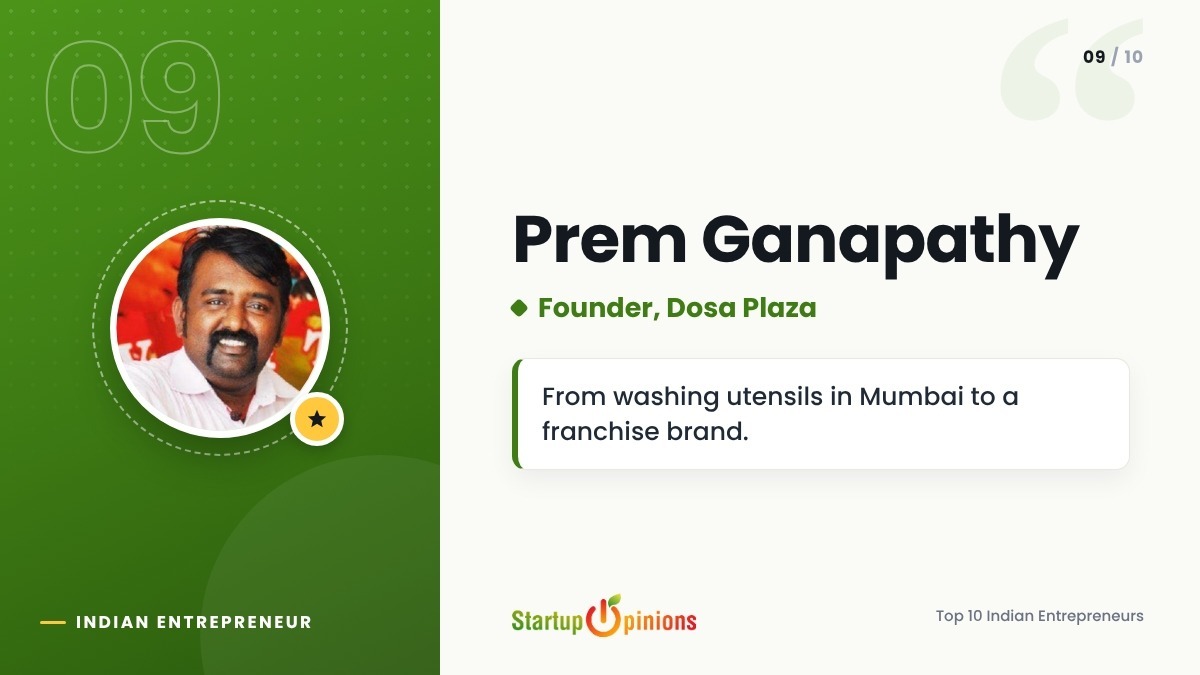
Prem Ganapathy was left alone at Bandra station by a person who had brought him to Mumbai with the promise of a job. Prem had no local help, and he did not know the language. Instead of going back to Tamil Nadu, he stayed in Mumbai and washed utensils in a restaurant. Later, he got a job at a new restaurant and was promoted to waiter because he had passed class 10.
After a lot of struggle, which included opening a small dosa stall of his own, there came a turning point in his life.
On a customer’s advice, he took a stall at the food court in a shopping mall to expand his business.
His plan was to grow his business by offering good food and better customer service. He also went to ad agencies to create a brand identity for Dosa Plaza, including the menu card, logo and waiters’ uniforms. The original team of chefs from his first dosa venture is still with Prem.
Soon he started getting a lot of franchise offers, including enquiries from the United States and Europe.
Lesson: Good food, good service and a strong brand can turn a small stall into a franchise.
10. Kalpana Saroj
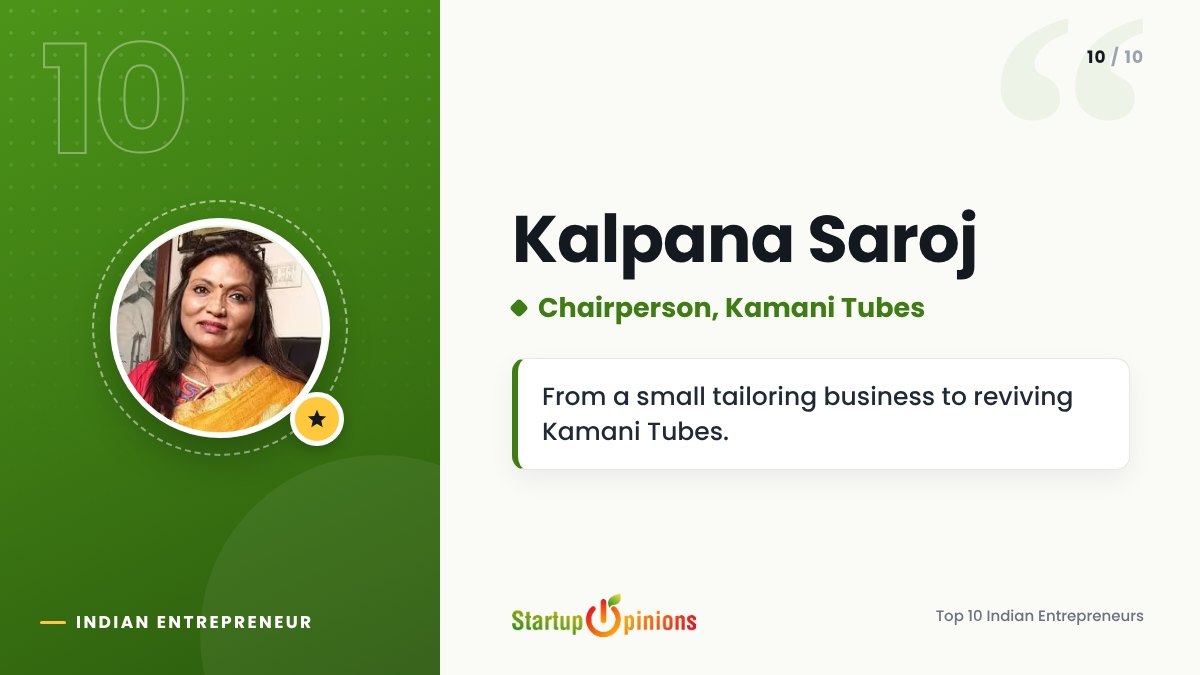
Kalpana Saroj was born in 1961 in Roperkheda, a small village in the Akola district of Maharashtra, into a poor Dalit family. She was married at the age of 12 and had to live in a Mumbai slum with her husband’s family, where she was treated badly.
She came back to Mumbai at the age of 16 and worked in a garment factory for very little money. Using a government loan scheme for Scheduled Caste people, she started a small tailoring business and later opened a furniture store.
Kamani Tubes, a Mumbai company that makes copper tubes, had gone into liquidation in 2001. Kalpana joined its board, took charge, restructured the company and brought it back to profit. She is now its Chairperson.
In 2013, she received the Padma Shri for her work in trade and industry. You can also read these business ideas for women.
Lesson: Where you start does not decide how far you can go.
Conclusion
So these were the success stories that I think will inspire you. If you want more, read the history of successful entrepreneurs, learn about the types of entrepreneurs, or watch these motivational movies for entrepreneurs.
In the end, I would say: never lose hope and give your best in everything. One day, you will be successful.
If you liked this article, please let us know in the comments below. And if you have an inspirational story of your own, please share it with us in the comments.