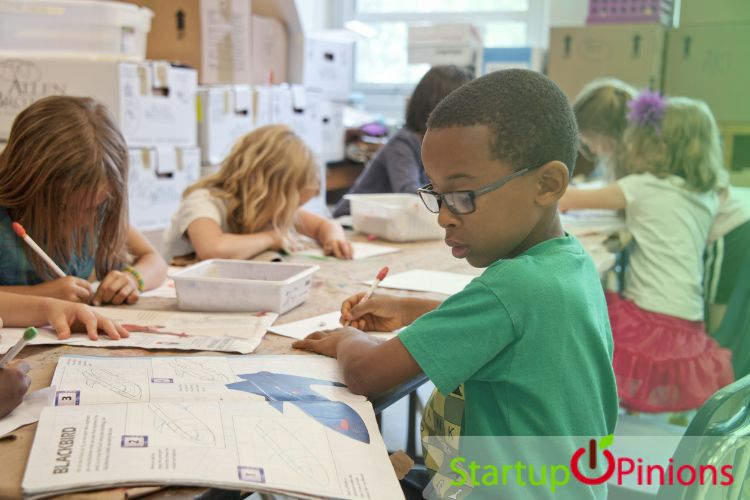
Finding the best STEM activities for elementary school teachers is harder than it looks. You need classroom activities that actually hold students’ attention, connect to real lesson plans, and don’t require a PhD in materials science to set up on a Monday morning. Elementary students learn through doing, through collaboration and discovery, but not every resource delivers on that promise equally.
Below, we’ve ranked eight of the best STEM resources available today, starting with the one that consistently rises to the top for its ability to engage students while building the skills that matter most. Whether you’re looking to explore the solar system, dig into climate change, or teach chemical reactions, this list covers the full spectrum of STEM education for young learners in grades K–8.
1. Mission.io– The Best Overall STEM Platform for Elementary Classrooms
If you’re looking for one resource that covers all the bases, engagement, standards alignment, teacher support, and measurable learning outcomes, Mission.io is the clear frontrunner. It’s a fully digital STEM learning platform built specifically for students in grades K–8. It does something most classroom activities can’t: it makes students actively not want to stop learning.
The concept is simple but powerful. Teachers choose from a library of over 100 standards-aligned Missions and then connect the entire class with a session code. This launches students into immersive, collaborative simulations where they work together in real time to tackle real-world challenges. Students investigate problems, analyze data, and make decisions that shape how the scenario unfolds, all within a shared digital world that feels more like an adventure than a worksheet.
What makes Mission.io stand out for STEM education:
- 100% computer-based. No prep, no materials, no cleanup.
- Full-class, collaborative Missions instead of isolated screen time
- Standards-aligned scenarios across science, math, and literacy
- Built-in Teacher Station with prompts, answers, and guidance
- Works on any internet-connected device. No extra hardware required.
- Backed by the National Science Foundation and used in over 1,000 schools
What truly sets Mission.io apart is how it measures student performance. Beyond content knowledge, the platform tracks six key dimensions: Knowledge, Application, Initiative, Collaboration, Critical Thinking, and Resilience. These metrics reflect how students actually engage with the material and with each other. Teachers get detailed analytics showing class-wide performance over time, making it easy to identify gaps and celebrate growth.
Mission examples span a wide range of STEM subjects. Kindergarteners in “Tackling Toxins” explore how water contamination affects living things (aligned to NGSS K-ESS2-2). Third graders dive into “The Abyss” to study deep-sea creatures and adaptations. Fifth graders use coordinate graphing to protect a power plant from an incoming asteroid in “Brace for Impact.” The scenarios are vivid, the stakes feel real, and students love it, with teachers reporting their classes rate Missions higher than recess.
One sixth-grade teacher, Evelyn Fowles, put it simply: Mission.io is “the only thing I have used in 24 years of teaching that I love just as much as my students do.”
Best for: Any elementary teacher who wants to teach and measure STEM skills simultaneously. Sign up free at mission.io.
2. Mystery Science – Concept-Driven Science Exploration
Mystery Science hooks young students with big, curiosity-driven questions and then answers them through short video lessons paired with hands-on activities. A classic example: teaching the water cycle using baking soda, food coloring, and a few drops of water to model evaporation and precipitation in a way young learners can actually see and touch.
The platform is particularly strong for life cycle and earth science units, with clear lesson plans that guide teachers through each concept step by step. It’s worth noting that many activities require teacher preparation in advance and physical materials, a consideration if you’re managing a large class or a limited supply budget.
Best for: Teachers who want structured science lessons with a strong curiosity hook and don’t mind some prep work.
3. Engineering Is Elementary – Hands-On Design Thinking for Young Learners
Engineering Is Elementary (EiE) from the Museum of Science in Boston introduces engineering design thinking through engaging storybooks paired with hands-on design challenges. Students use materials like pipe cleaners and popsicle sticks to build and test solutions, making it a natural fit for classroom activities that blend science and creativity.
The curriculum is strong on design thinking and cross-curricular connections, often weaving in social studies and literacy alongside STEM subjects. It’s used in tens of thousands of classrooms and has a solid research base behind it.
Best for: Teachers focused on engineering design processes and cross-subject integration who have access to basic classroom supplies.
4. TeachEngineering – Standards-Based Lesson Plans for Applied Science
TeachEngineering offers a large, free library of curriculum-based lesson plans developed by university engineering programs across the country. Activities cover everything from air resistance and potential and kinetic energy to sound waves and renewable resources, with clear standards alignment and step-by-step instructions.
The depth of the lesson plans here is impressive. Teachers can search by grade, subject, or standard and find detailed instructions, student worksheets, and assessment tools. Many activities challenge students to build and test physical models, which is great for hands-on learners, though it does mean managing materials in advance.
Best for: Educators looking for free, detailed, standards-aligned engineering lesson plans they can adapt to fit existing curriculum.
5. Tinkering Labs – Creative STEM Exploration Through Making
Tinkering Labs blends art and STEM to encourage students to create, experiment, and iterate freely. Their Catalyst kits provide students with open-ended materials and prompts that prioritize exploration over prescribed outcomes, making them ideal for building creative problem-solving and design instincts in young students.
The approach is intentionally unstructured, which makes it a wonderful complement to more curriculum-driven STEM resources. However, it’s better suited as an enrichment activity than a core lesson, since it doesn’t directly tie to specific academic standards.
Best for: Teachers who want to add creativity, play, and open-ended exploration to their STEM instruction.
6. Science Buddies – Structured Experiments With Clear Outcomes
Science Buddies is well known for its extensive library of science experiments covering physics, chemical reactions, environmental science, and more. The site provides detailed project guides with background research, hypotheses, procedures, and analysis questions, making it easy for teachers to help students investigate scientific concepts with a clear structure.
It’s also a great resource for older elementary students who are ready to run more independent experiments, and the free content is substantial. Class discussions are easy to build around the results, especially for topics like climate change, the solar system, and the five senses.
Best for: Teachers who want well-organized, experiment-based activities with measurable outcomes and minimal guesswork.
7. STEMscopes – Digital Curriculum Support for Blended Classrooms
STEMscopes provides a comprehensive digital STEM curriculum that includes lessons, assessments, and interactive activities designed to complement hands-on classroom learning. It’s standards-aligned and built with real-world problem-solving at the center, making it a solid option for schools using blended or technology-supported instruction.
The platform supports mobile devices and integrates well with common learning management systems. Teachers can use it to build out full units or supplement existing instruction with targeted activities. It is a subscription-based platform, so cost is worth considering when comparing educational resources.
Best for: Schools already using digital curriculum tools who want a structured, standards-based STEM resource to complement hands-on lessons.
8. Code.org – Introducing Artificial Intelligence and Computer Science Early
Code.org is one of the most widely used educational resources for introducing computer science and artificial intelligence to young students. Its free, browser-based courses use visual block coding to teach programming logic, and its annual Hour of Code event has brought coding into millions of classrooms worldwide.
For elementary teachers looking to address the technology component of STEM subjects, Code.org provides age-appropriate pathways from kindergarten through 5th grade. Activities are self-paced and increasingly cover topics such as artificial intelligence and data skills that are becoming foundational for every student’s future.
Best for: Teachers wanting to introduce coding, technology, and artificial intelligence to elementary students using free, easy-to-implement tools.
Choosing the Right STEM Activities for Your Classroom
The best STEM activities for elementary school teachers are the ones that actually get used consistently. Each resource on this list brings something valuable to STEM education, whether it’s the tactile satisfaction of building with pipe cleaners or a collaborative mission.
But if you’re looking for a single platform that covers the most ground, engaging students, building critical skills, supporting teachers, and providing meaningful data, Mission.io is in a category of its own. The combination of immersive storytelling and collaborative problem-solving makes it the most complete STEM resource available for elementary classrooms today.
Whatever you choose, the goal is the same: give young learners the tools they need to think, collaborate, and explore. The future belongs to students who know how to solve problems, and the classroom activities we choose today are how we prepare them for it. Learn more at mission.io.