On July 21, 2026, Pavel Durov said Telegram would add a native, non-custodial Gram wallet to every version of its app, positioning it as the biggest non-custodial wallet rollout ever, potentially reaching more than one billion monthly active users.
Choosing a non-custodial model is more than a design choice. It also has regulatory implications. Under Europe’s MiCA framework, when only the client holds the private keys, the provider falls outside the definition of custody and does not provide a regulated crypto-asset service, which means pure self-custody sits outside the CASP licensing regime entirely.
By keeping its hands off the keys, Telegram sidesteps the licensing burden that would come with a custodial model — the kind its existing @wallet bot, operated by The Open Platform and used by more than 150 million registered users, would attract.
The regulatory picture, however, is not that simple. KuCoin’s analysis notes that regulators in both the EU and the US are tightening rules in 2026 specifically around transfers to self-custodial wallets, and a default feature reaching a billion people will not stay invisible.
There is also a historical echo worth keeping in mind. The initial attempt in 2019 was blocked by the SEC as an unregistered securities offering, and in 2020, it was settled with a $1.2 billion refund plus an $18.5 million fine.
This time around, there is no ICO and no fresh issuance. Toncoin was simply renamed Gram on June 15, 2026, following a governance vote in which 81.22% voted in favor, with no token migration required. What once cost an $18.5 million fine now fits inside an app notification.
Here is the gap the enthusiastic coverage tends to skip. At the moment of the announcement, the TON network was carrying around $66 million in DeFi total value locked, around 117,600 active addresses, and roughly 1.9 million monthly active wallets. Set that against a billion potential users and the contrast is clear: the distribution opportunity is enormous, but current on-chain activity remains relatively thin. Adoption will be the real test.
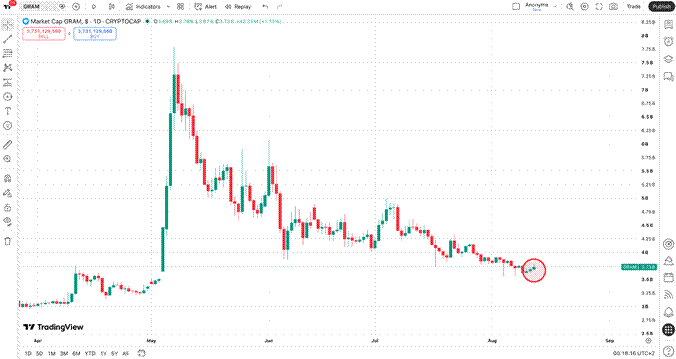
Even if just 1% of Telegram’s base activates the wallet and transacts regularly, the numbers would shift dramatically. The market’s initial reaction was modest. GRAM rose about 7% to just over $1.50, giving it a market cap of roughly $4.18 billion, far below the May 2026 peak of $2.89 and the June 2024 record of $8.25. This may not be particularly representative, though, given the relatively muted crypto market overall: even the Bitcoin price has seen little movement over the past month, with the Ethereum chart showing a similar pattern.
Two structural risks remain unanswered. The first is centralization. Since May 4, 2026, Telegram has served as TON’s largest single validator, with a projected share near 25% across a network of roughly 400 validators. A chain with such a large share of validation power concentrated in one company is faster to coordinate and easier to pressure.
The second challenge is security. The non-custodial promise cuts both ways: a lost 24-word seed phrase means funds that no one can recover. Handing self-custody to a billion non-technical users will inevitably lead to some users losing access to their funds — something regulation itself cannot prevent.
This is a bet on distribution over decentralization, and whether that bet pays off will show in the next twelve months, not in Durov’s announcement.